Security operations

What is AI-Native XDR?

What AI-native XDR really is, how it differs from XDR, EDR and SIEM, the limits worth knowing and how it maps to NIS2 and Cybersäkerhetslagen in Sweden.

What is AI-Native XDR
Key takeaways

  • AI-native XDR (AI XDR) is extended detection and response with machine learning at its core, correlating signals across endpoint, network, identity, cloud and email into one attack picture.
  • It differs from bolt-on AI, where machine learning is a feature on an old rules engine rather than the detection core itself.
  • Most damaging attacks cross domains. The IBM Cost of a Data Breach Report 2025 found 30% of breaches spanned multiple environments, costing the most at USD 5.05 million and lasting 276 days.
  • The global average breach lifecycle was 241 days in 2025, 181 days to identify and 60 to contain, per IBM.
  • Organisations using AI and automation extensively in security operations saved an average of USD 1.9 million per breach and cut the lifecycle by 80 days, per IBM.
  • Detecting a breach internally saved about USD 900,000 versus being told by the attacker, per IBM.
  • XDR comes in three shapes, native from one vendor, open or hybrid across best-of-breed tools and managed (MXDR) when a provider runs it for you.
  • No platform runs a fully autonomous SOC. Anomaly detection trades false positives against false negatives, and a human still owns high-impact decisions.
  • The recent MGM, Change Healthcare and Marks and Spencer breaches all began with identity compromise then spread across domains, the seam XDR is built to watch.
  • In Sweden, Cybersäkerhetslagen (in force since 15 January 2026) requires organisations to implement cybersecurity risk-management measures, with significant incidents reported within 24 hours, 72 hours and one month to the National Cyber Security Centre (NCSC) at FRA, through CERT-SE.

AI-Native XDR Defined in Plain Terms

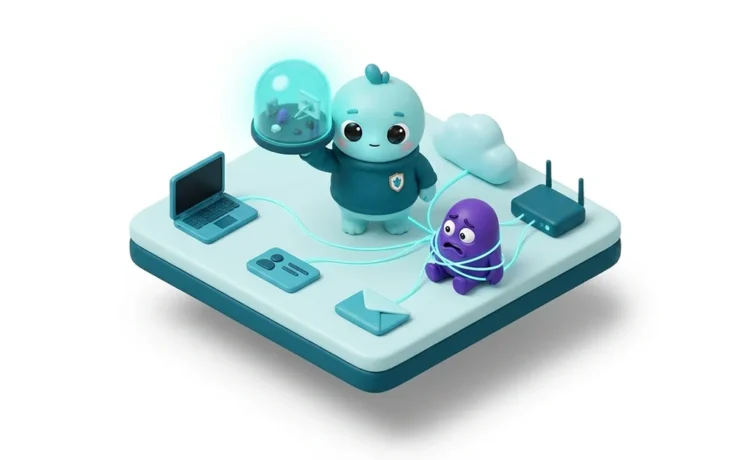
AI-native XDR, or AI XDR, is extended detection and response built with machine learning at its core. It collects security signals from across endpoints, networks, identity systems, cloud and email, then uses AI to correlate them into one attack picture and to speed up investigation and response.

The problem it answers is simple. Most attacks now move across several systems and most security tools watch only one. The IBM Cost of a Data Breach Report 2025 found that 30% of breaches involved data spread across multiple environments, and these cost the most at USD 5.05 million and took the longest to contain at 276 days.

Traditional XDR already stitches these signals together. The AI-native part means the platform is designed around machine learning rather than fixed rules, so it can spot patterns a person would miss and clear the noise before an analyst ever sees it.

How AI-Native XDR Works

An AI-native XDR platform turns raw signals into a decision in three stages.

How AI-Native XDR Works

Unified telemetry: The platform pulls data from endpoints, network traffic, identity providers, cloud workloads and email into one place, so a single event can be seen from every angle.

Machine-learning detection: Instead of waiting for a rule to match, models learn what normal looks like for your estate and flag the behaviour that deviates. This is the same AI anomaly detection idea applied across domains, and related events are then correlated into a single incident.

Agentic triage and response: Newer platforms add AI agents that investigate an alert, gather context and either recommend a response or carry out a contained action such as isolating a device, with a human approving the high-impact steps.

This is where AI-native differs from bolt-on AI. Almost every product now claims machine learning, but many run it as a feature on top of an old rules engine. AI-native means the detection core itself is the model, running on unified data rather than on one domain.

Types of AI XDR: Native, Open and Managed

XDR comes in three broad shapes and the right one depends on the tools you already run and the size of your team.

  • Native XDR: One vendor supplies the whole stack, from sensors to analytics. It is the simplest to deploy and the signals line up cleanly, but it ties you to that vendor’s ecosystem.
  • Open or hybrid XDR: The platform correlates data from tools you already own, so you keep best-of-breed products at the cost of more integration work.
  • Managed XDR (MXDR): A provider runs the platform and the analysts for you. This is close to a managed detection and response service and suits teams with no 24-hour security operations centre of their own.

The AI layer applies to all three. What changes is who tunes the models and who runs the response out of hours.

The Business Case for AI XDR

The case for AI XDR is a time problem. The longer an attacker stays undetected, the more a breach costs.

The IBM Cost of a Data Breach Report 2025 put the global average breach lifecycle at 241 days, the mean time to detect and respond to an incident. That is 181 days to spot it and 60 more to shut it down, and every one of those days adds cost.

The same report found that organisations using AI and automation extensively across their security operations saved an average of USD 1.9 million per breach and cut the breach lifecycle by an average of 80 days.

Finding the breach yourself matters too. Organisations that detected an incident internally saved about USD 900,000 compared with those first told by the attacker. Cross-domain visibility is what makes early internal detection possible.

None of this is about buying more dashboards. It is about seeing the whole attack in one view and acting before the ransomware runs.

Real-World Cases

The attacks that hurt most in recent years did not stay in one place. Each of the cases below crossed from identity into cloud, endpoint or the wider network, which is exactly the seam a single-domain tool misses.

MGM Resorts, 2023

In September 2023 the group tracked as Scattered Spider, working as an ALPHV/BlackCat affiliate, found an MGM employee on LinkedIn and phoned the IT help desk posing as them. The help desk reset the account’s credentials and multifactor authentication.

That reset handed the attackers administrator access to MGM’s Okta and Azure environments. They moved into the virtual infrastructure and, by the attackers’ own account, encrypted more than 100 VMware ESXi hosts. The disruption ran for about ten days.

Real world cases Ai native XDR

MGM’s filing with the US Securities and Exchange Commission estimated a negative impact of about USD 100 million, and the company did not pay a ransom. A platform that linked the identity reset to the strange admin logins and the mass encryption that followed could have raised one correlated alarm instead of three unconnected ones.

Change Healthcare, 2024

On 12 February 2024 an ALPHV/BlackCat affiliate logged into a Change Healthcare remote-access portal using stolen credentials. The portal had no multifactor authentication. The attackers then moved through the network for about nine days before launching ransomware on 21 February.

UnitedHealth, the owner, paid a USD 22 million ransom, but the stolen data was leaked anyway. Chief executive Andrew Witty later told the US Congress that the portal did not have multifactor authentication.

About 190 million people were affected, and UnitedHealth reported breach-related costs of more than USD 2.4 billion through the third quarter of 2024, which it expected to reach about USD 2.9 billion for the year.

Two controls would have changed this. Multifactor authentication on the portal would have blocked the entry, and behavioural detection of the nine days of lateral movement would have turned a long silent dwell into an early warning.

Marks and Spencer, 2025

Over the Easter weekend in April 2025 attackers linked to Scattered Spider, using DragonForce ransomware, talked Marks and Spencer’s outsourced IT help desk into resetting a privileged account. From there they reached domain administrator and encrypted the retailer’s VMware infrastructure.

Customer data was stolen and online ordering stayed down for about seven weeks. In its May 2025 results M&S estimated the attack would cut operating profit by about GBP 300 million before insurance and mitigation.

The pattern should look familiar. The same help-desk route that hit MGM in 2023 worked again in 2025, which is why phishing-resistant multifactor authentication and strict help-desk identity checks sit alongside cross-domain detection, not instead of it.

AI XDR and Compliance

In Sweden the case for continuous detection is now written into law, so AI XDR is not only an operational choice.

The Swedish NIS2 law, Cybersäkerhetslagen (SFS 2025:1506), came into force on 15 January 2026. Article 21.2a requires policies on risk analysis and information system security and 21.2b covers incident handling, with the reporting duties set out in Article 23. All of these map onto what cross-domain detection and response does. You can read more in our NIS2 compliance guide for Sweden.

The duty reaches the top. Article 20 makes the board responsible for security measures and lets supervisors hold members personally accountable.

When an incident hits, the reporting clock is tight. You have 24 hours for an early warning, 72 hours for a full notification and one month for the final report. Since 1 July 2026 these go to the National Cybersecurity Centre (NCSC) at FRA, which took over CERT-SE and the NIS2 contact point from MCF (formerly MSB) and forwards each report to your sector authority. Faster detection buys you time to meet the clock.

Other regimes point the same way. Under DORA, Article 17 sets ICT incident-management duties for financial entities supervised by Finansinspektionen. Under GDPR, Article 33 gives you 72 hours to notify IMY of a personal-data breach, and ISO 27001 adds controls for continuous monitoring and incident management.

There is a catch when the defence itself runs on AI. The EU AI Act takes a risk-based approach and expects human oversight, logging and clear accountability for automated decisions. Running AI in the security operations centre brings the same governance NIS2 already asks for, yet the IBM report found 63% of organisations have no AI governance policy at all.

How to Tell Real AI XDR from an AI Label

Every vendor now puts AI on the box, so the useful skill is telling a real AI-native platform from a sticker. A few questions separate the two.

  • Where does the AI sit: Ask whether machine learning is the detection core running on unified telemetry or a feature bolted onto a single-domain rules engine.
  • What data does it see: The model is only as good as the telemetry it ingests, so weak coverage of identity, cloud or network limits what any AI can find.
  • What does it do on its own: Check which actions are automated, which need a human to approve and how an analyst reverses a wrong one.

Then treat the big claims with care. No production platform runs a fully autonomous security operations centre, and anyone promising zero false positives is selling. Anomaly detection trades false alarms against missed ones, so turning sensitivity up catches more threats and more noise at the same time.

Alert quality is the real test. A 2022 University of Oxford study at the USENIX Security Symposium found that analysts perceive almost all the alerts they handle as false positives, which is the burnout AI is meant to ease. Good AI XDR reduces that load but a human still owns the high-impact calls.

How to Adopt AI-Native XDR

Adopting AI XDR is as much about people and process as it is about the platform, whether you run it yourself or buy it as an AI detection and response service. A practical path looks like this.

How to Adopt AI-Native XDR
  • Map your telemetry first. List the endpoint, identity, cloud, network and email sources the platform must ingest, and fix the gaps before you buy.
  • Start with the attack paths that hurt. Prioritise identity and lateral-movement detection, since that is the route the recent ransomware cases took.
  • Decide what the AI may do alone. Set clear rules for automated containment and keep a human in the loop for high-impact actions.
  • Tune and review the models. Feed back false positives, retrain on your own environment and check that detections still fire after every change.
  • Rehearse the response. Run the playbook end to end so the team trusts the alerts and knows the steps when a real incident lands.

The technology shortens detection and response. The people behind it decide whether a confirmed alert becomes a contained incident or a missed one, so invest in the analysts as much as the platform.


Myths & Facts

Myth

AI XDR replaces your security team.

XDR and EDR are the same thing.

If a product says AI, the detection is AI-native.

AI XDR removes false positives.

XDR is only for large enterprises.

Buying XDR makes you NIS2 compliant.

Fact

No production platform runs a fully autonomous SOC. AI XDR handles triage and routine response but a human still owns the high-impact decisions and the edge cases.

EDR watches the endpoint. XDR correlates signals across endpoint, network, identity, cloud and email, so it can catch an attack that crosses domains and EDR alone would miss.

Most tools add machine learning as a feature on an old rules engine. AI-native means the detection core itself is the model, running on unified cross-domain telemetry.

Anomaly detection trades false positives against false negatives. Good AI XDR cuts the noise sharply but no system reaches zero, and raising sensitivity flags more of both.

XDR often helps small teams more, because it automates the correlation work that would otherwise need several senior analysts. Managed XDR extends this to teams with no 24-hour SOC.

XDR supports NIS2 Article 21.2a monitoring and faster incident reporting but compliance also needs governance, board oversight and tested processes. The platform is one control among several, so it supports compliance without delivering it on its own.

Test Yourself

Four real-world scenarios, then six knowledge questions. See how prepared you would be under pressure.

Scenario Simulation

  1. Your IT help desk gets a call from someone who sounds like a senior manager, says they are locked out before a board meeting and asks for a password and MFA reset on the spot.

    What is the safest response?

    • Reset it quickly so the manager is not blocked
    • Verify identity through a separate trusted channel before any reset
    • Ask for the manager's date of birth and employee number
  2. Within an hour your tools show a privileged account's MFA was reset, that account then logged in from an unusual location and a burst of files began encrypting on a virtual host.

    What does an AI-native XDR platform do that three separate tools would not?

    • Correlate the three events into one incident and act
    • Raise three separate low-priority alerts
    • Wait for an analyst to connect the dots manually
  3. A vendor tells you their AI XDR runs a fully autonomous SOC with zero false positives and needs no analysts.

    How should you read this claim?

    • Treat it with caution, as no production platform does this
    • Buy it, since it removes the need for a security team
    • Assume all AI XDR products work the same way
  4. Your AI XDR confirms a significant incident at a Swedish essential entity on a Monday morning.

    What does Cybersäkerhetslagen require first?

    • An early warning within 24 hours to the National Cyber Security Centre (NCSC) at FRA, through CERT-SE (which took over from MCF on 1 July 2026)
    • A full technical report within 24 hours
    • Nothing until you have fully contained it

Knowledge Test

  1. What makes XDR AI-native rather than bolt-on?

    • Machine learning is the detection core running on unified telemetry
    • It has an AI chatbot in the dashboard
    • It uses more rules than an older product
    • It stores logs for longer

    AI-native means the detection core itself is the model running on unified cross-domain data rather than a feature added to a rules engine.

  2. In the IBM Cost of a Data Breach Report 2025, how much did organisations using AI and automation extensively in security operations save on average per breach?

    • USD 1.9 million
    • USD 100 million
    • USD 22 million
    • USD 900,000

    Extensive use of AI and automation saved an average of USD 1.9 million per breach and cut the lifecycle by 80 days.

  3. Why are breaches that span multiple environments a particular problem?

    • They were the most expensive at USD 5.05 million and took longest to contain
    • They are always caught instantly
    • They only affect cloud systems
    • They never involve identity

    IBM found 30% of breaches spanned multiple environments, costing the most at USD 5.05 million with the longest lifecycle at 276 days.

  4. What did the MGM, Change Healthcare and Marks and Spencer breaches have in common?

    • Each began with identity compromise then spread across domains
    • Each was a pure hardware failure
    • None involved ransomware
    • Each was stopped within minutes

    All three started with compromised or reset credentials and moved across identity, cloud or endpoint, the seam XDR is built to watch.

  5. What is a fair description of anomaly detection in AI XDR?

    • It trades false positives against false negatives and never reaches zero
    • It removes all false positives
    • It replaces the need for telemetry
    • It only works on email

    Higher sensitivity catches more threats and more noise, so no system reaches zero false positives and a human still reviews high-impact calls.

  6. Under Cybersäkerhetslagen, when is the early warning to NCSC at FRA, through CERT-SE due after a significant incident?

    • Within 24 hours
    • Within 72 hours
    • Within one month
    • Only after containment

    The cascade is 24 hours for an early warning, 72 hours for a full notification and one month for the final report.

Take It with You

Share the Summary PDF with Your Team

A short distilled brief in PDF: key findings, red flags and action steps.

Download summary PDF

Why Training Matters

AI XDR shortens the time to detect and contain an attack, but the recent cases share a human starting point. MGM, Change Healthcare and Marks and Spencer all began with someone being persuaded to reset an account or hand over access.

The platform cannot approve a help-desk reset or question an odd request. People do that. Security awareness training for help-desk staff and employees closes the gap that technology alone leaves open, so the alerts your XDR raises are fewer and clearer.

Frequently Asked Questions

What is AI XDR?

AI XDR, or AI-native extended detection and response, is a security platform with machine learning at its detection core. It collects signals from across endpoints, networks, identity, cloud and email, correlates them into one attack picture and speeds up investigation and response, so cross-domain attacks are caught earlier than siloed tools allow.

What is the difference between AI XDR and traditional XDR?

Traditional XDR correlates signals across security layers using mostly fixed rules with some machine learning added. AI-native XDR is built around machine learning from the start, so the detection core itself learns normal behaviour and flags deviations. The practical gain is fewer missed patterns and less manual triage for analysts.

What is the difference between XDR and EDR?

EDR, endpoint detection and response, watches activity on laptops, servers and other endpoints. XDR extends that view across network, identity, cloud and email and correlates the signals, so it can reconstruct an attack that moves between domains. EDR gives depth on the host, and XDR gives breadth across the estate.

Is XDR the same as SIEM or SOAR?

No. A SIEM collects and stores logs and raises alerts, and a SOAR automates response through playbooks. XDR focuses on cross-domain detection and correlation and increasingly adds AI-driven response. Many organisations run them together, with the SIEM holding long-term data and XDR doing real-time detection.

What is next-gen XDR?

Next-gen XDR usually means an AI-native platform that folds agentic AI into the XDR core. Instead of only correlating alerts, AI agents investigate an incident, gather context and recommend or take a contained response, with a human approving high-impact actions. The label is marketing, so check what the AI actually does.

Does AI XDR replace human analysts?

No. No production platform runs a fully autonomous security operations centre. AI XDR removes much of the repetitive triage and speeds investigation, which eases analyst burnout but humans still own the high-impact decisions, the edge cases and accountability for any automated action that affects live systems.

Does AI XDR help with NIS2 and Cybersäkerhetslagen?

Yes, in part. NIS2 Article 21.2a requires continuous monitoring and 21.2b covers incident handling, both of which XDR supports directly, and faster detection helps you meet the 24-hour and 72-hour reporting deadlines to the National Cyber Security Centre (NCSC) at FRA, through CERT-SE, which took over from MCF on 1 July 2026. Compliance still needs governance, board oversight and tested processes, so XDR is one control among several.

What is managed XDR (MXDR)?

Managed XDR, or MXDR, is XDR delivered as a service. A provider runs the platform, tunes the models and staffs the analysts who triage and respond, often around the clock. It suits organisations that want cross-domain detection and response but do not have a 24-hour security operations centre of their own.

You Understand the Risk.
Now See Where You Stand.

Book a 30-minute briefing with one of our analysts, or run the free breach check first to find out what attackers already know about your organisation.

Book a 30-Min Briefing
No sales pitch, just a straight assessment

How eBuilder Security Can Help

Awareness is the first layer. These are the services that turn it into measurable protection.